7 Outlook
Environmental impact of €100 billion in arms investments
[back to table of contents]
7.1 Problem outline Conflicts and climate change
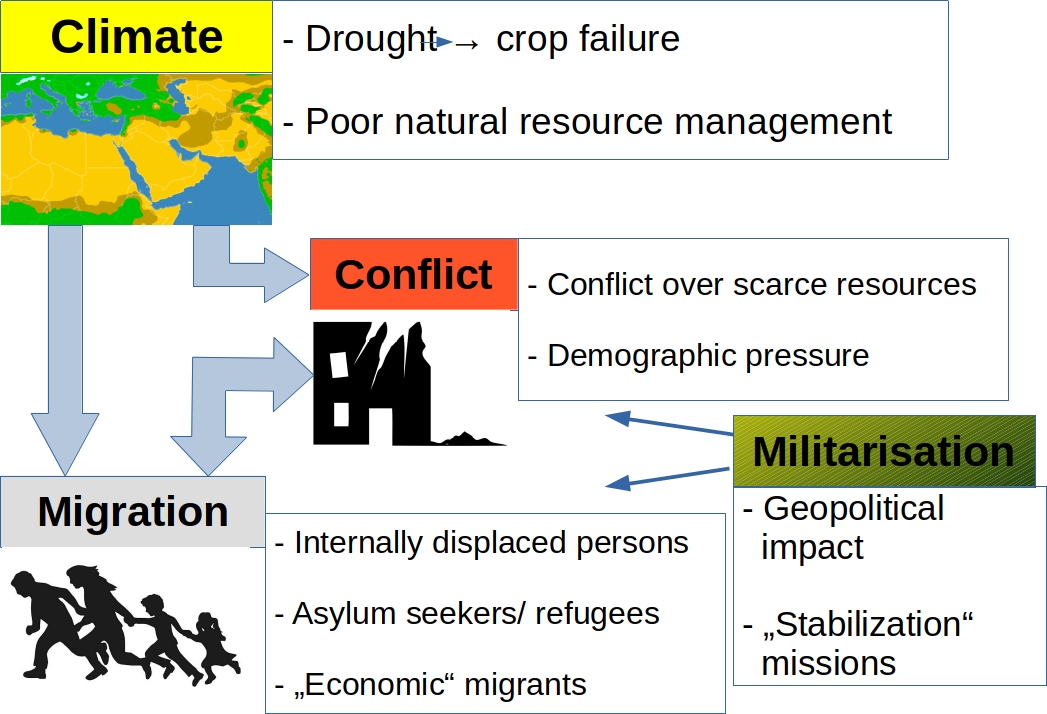
| Fig. 7-1: Dependencies and impacts of climate change The connection between the consequences of climate change and military conflicts is complex. As a rule, conflicts arise from a mixed situation in which climate change can be seen in individual cases as one of several causes as well as a catalyst. Military interventions only have an effect on symptoms, but never on causes. |
Even such armed conflicts as the Ukraine war, which are not directly linked to the effects of climate change, can have at least indirect repercussions in this regard.
The war highlights the weaknesses of previous climate and sustainability policies as much as it underlines their urgency. At the same time, it undermines sustainable solutions by diverting funds and resources, shifting public attention, destabilising markets, affecting cooperation, triggering geopolitical conflicts, destroying nature and society through armament and war. Trust, participation and cooperation, which are urgently needed for the necessary common solutions, are likely to become even scarcer. The permanent crisis mode of political reactions is shrinking the room for manoeuvre for shaping a global sustainable future.1Spangenberg u. Kurz. 2022: Turning point: Uncomfortable Insights, Uncertain Prospects
7.2 Alternative concepts
The four German peace research institutes publish an annual Peace Report (FG) with different thematic focuses. Although these reports are a helpful source of information, they have no practical consequence for government policy2Regarding the self-imposed claim, the joint homepage states: „In it, scholars from various disciplines examine international conflicts from a peace strategy perspective and provide clear recommendations for policy.“ https://friedensgutachten.de/ueber-uns, as many problems are named in detail, but no fundamental alternatives are developed. In the Peace Report 2022, for example, German arms deliveries to Ukraine are welcomed.
The FG 2020 addressed the extent to which climate change can be assessed as a security risk.3https://friedensgutachten.de/archiv/2020/ausgabe As an example of a very academic view, it states: „The demonstrable effects of climate change on violent conflicts are, however, limited so far. Simplifying assumptions that climate change necessarily leads to more violence and war are not tenable.“ What is remarkable about this is that this topic was already dealt with by government agencies many years ago.4Title: World in Transition – Climate Change as a Security Risk https://www.wbgu.de/fileadmin/user_upload/wbgu/publikationen/archiv/wbgu_jg2007.pdf For example, the German Advisory Council on Global Change wrote in a 2007 report that „climate-induced security risks in world regions“ could be expected from around 2025 if climate protection efforts failed.
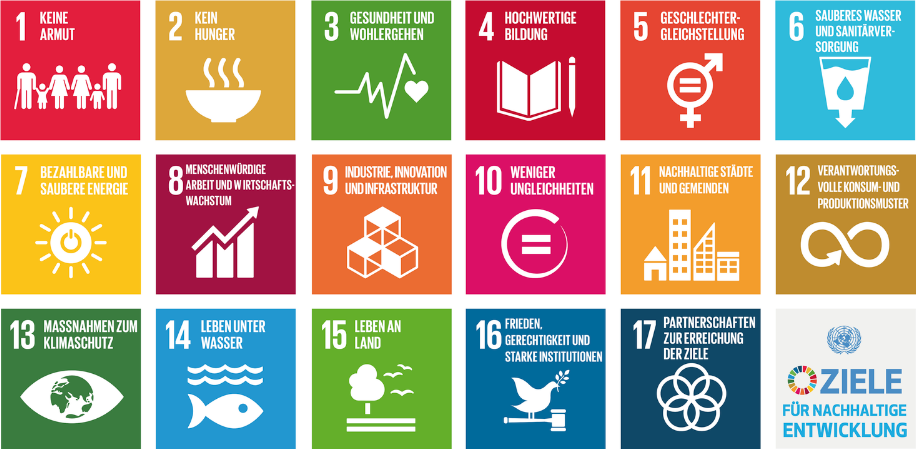
| Fig. 7-2: UN Sustainable Development Goals – Agenda 2030 (Graph: UNO) Individual SDGs are also cited, for example, in the latest sustainability reports of the BMVg. However, while security concepts with large-scale military equipment are naturally designed for interstate conflicts, the UN Sustainable Development Goals (SDGs) with Goal 17 explicitly call for comprehensive international cooperation to achieve the 16 individual goals. |
In the meantime, in addition to potential climate conflicts, it is also necessary to consider possible conflicts over access to scarce resources, which would be further fuelled by a significant increase in military resource consumption (and if these conflicts lead to military action, could establish a vicious circle of crisis and intervention).
Alternatives to military defence
At this point, only brief reference is made to concepts that have existed in part for many years and are frequently introduced into peace policy discourses. They have in common that they would – intentionally or as a side effect – significantly reduce the consumption of resources compared to a conventional security policy. The concepts range from demands for efficient military equipment to fundamental pacifist criticism. The latter goes back historically to the end of the 19th century and the commitment of Bertha von Suttner, who in 1905 was the first woman to be awarded the Nobel Peace Prize. A currently widespread approach is „civil conflict transformation „, which is propagated by various peace organisations.
Concept „Common Security“
The term „Common Security“ comes from the report of the same name chaired by the then Swedish Prime Minister Olof Palme and presented to the 2nd UN Special Session on Disarmament in 1982. The six original principles of the Palme Commission, against the background of the arms race between the USA and the Soviet Union (or NATO and the Warsaw Pact) at that time, were:
1. all nations have a legitimate right to security
2. military force is not a legitimate means of resolving disputes between nations
3. restraint is necessary when expressing national policy
4. security cannot be achieved by military superiority
5. reductions and qualitative limitations of armaments are necessary for common security
6. linkages between arms negotiations and political events should be avoided.
The Russian war of aggression against Ukraine broke these principles, but did not abolish them. While Russia must be made to reverse its disregard for the first three principles, its current opponents would be well advised to take the remaining three principles into account in their peace and post-war policies. Otherwise, there is a danger that the Ukraine war could have been the first of a whole series of further and escalating conflicts.
In this sense, the report „Common Security 2022“ published in April 2022 also emphasises:
The world is at a crossroads. It faces a choice between an existence based on competition and aggression or one based on a transformative peace agenda and shared security.
In 2022, humanity faces the existential threats of nuclear war, climate change and pandemics.5German version: https://www.ipb.org/wp-content/uploads/2022/04/2022-04-14_Palme-Report2.0-de.pdf

| Fig. 7-3: Common Security Report 2022 Editors are: the Olof Palme International Center, Stockholm, the World Trade Union Confederation (ITUC) and the International Peace Bureau (IPB). Graphic: SharePic from Homepage IPB |
Economic policy towards the global South
Socio-economic partnerships can only be called such, even against the background of the 2030 Agenda, if they are not dictated by economically stronger parties. Otherwise, they become strategies for the exploitation of the weaker party’s raw materials in connection with the development of sales markets for their own products. This would both exacerbate the climate crisis and fuel global military conflicts.
In this context, reference must be made to the fundamental ethical questions that were already addressed, for example, in 2008 in the study „Zukunftsfähiges Deutschland in einer globalisierten Welt“ 6Herausgeber: BUND, Brot für die Welt und Evangelischer Entwicklungsdienst, PDF version at: https://epub.wupperinst.org/frontdoor/deliver/index/docId/3016/file/3016_Zukunftsfaehiges_Deutschland.pdf by the Wuppertal Institute. This is especially true with the swing towards the use of LNG fuels and a hydrogen strategy, which would rely on global raw material suppliers and fragile supply chains, shift environmental burdens to poorer countries, permanently stamp them as raw material suppliers (neo-colonialism) and thus undermine all prospects for globally sustainable development.
7.3 Detailed requirements
Reporting and reduction targets
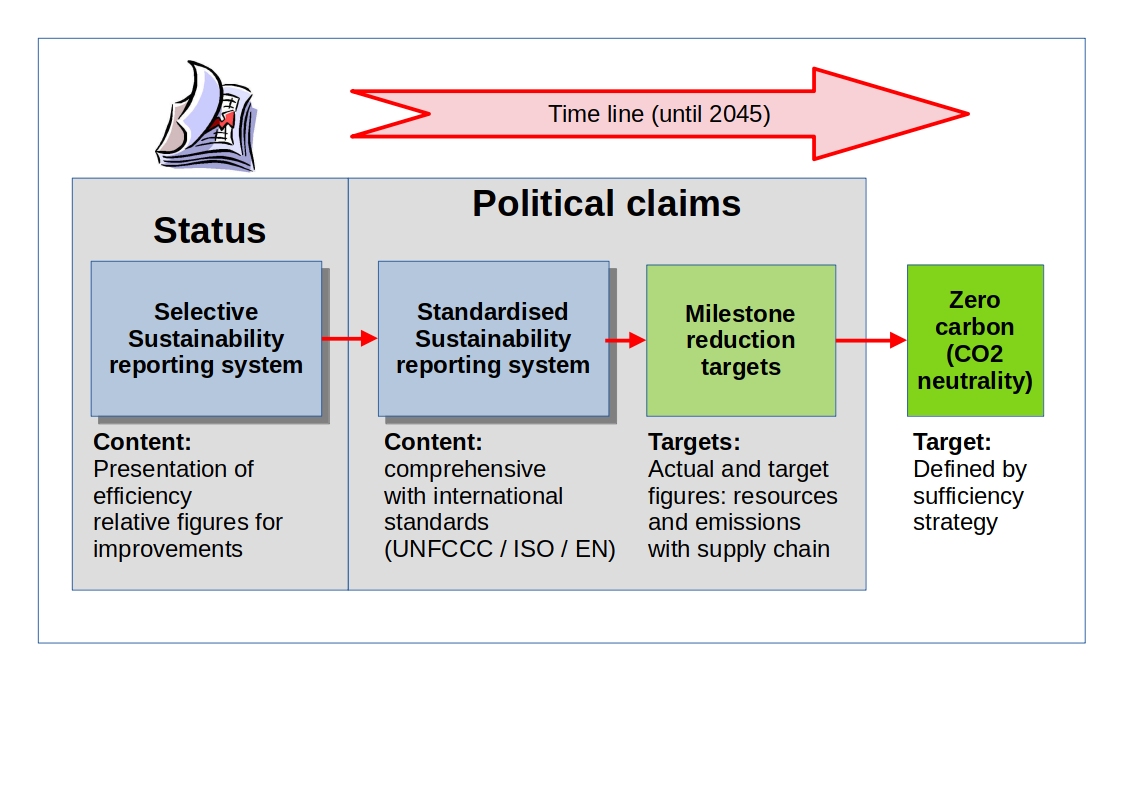
| Fig. 7-4: Reporting as a lever for resource savings and emission reductions This would be a link between the UBA’s proposals on resource efficiency and its presentation and a further development of the IPCC’s GHG reporting system. Existing international standards (ISO and EN standards) must be included here. |
Conceived as a demand to the World Climate Conference COP27, the full and obligatory inclusion of the military in the targets for reducing greenhouse gases is an urgently needed step. In order to be able to take this step in a verifiable manner, a standardised reporting system for military emissions is indispensable. This must not leave any of the existing scope for voluntary and selective reporting.
Industrial defence production with its upstream and downstream process chains must also be subject to these requirements. A corresponding British initiative („The military emissions gap“)7https://militaryemissions.org/ is based on an overall concept („Framework“) with comprehensive normative proposals, from which an excerpt is attached in Appendix A.7: Key categories for recording military greenhouse gases.8Cottrell, 2022
Rearmament versus socio-ecological transformation
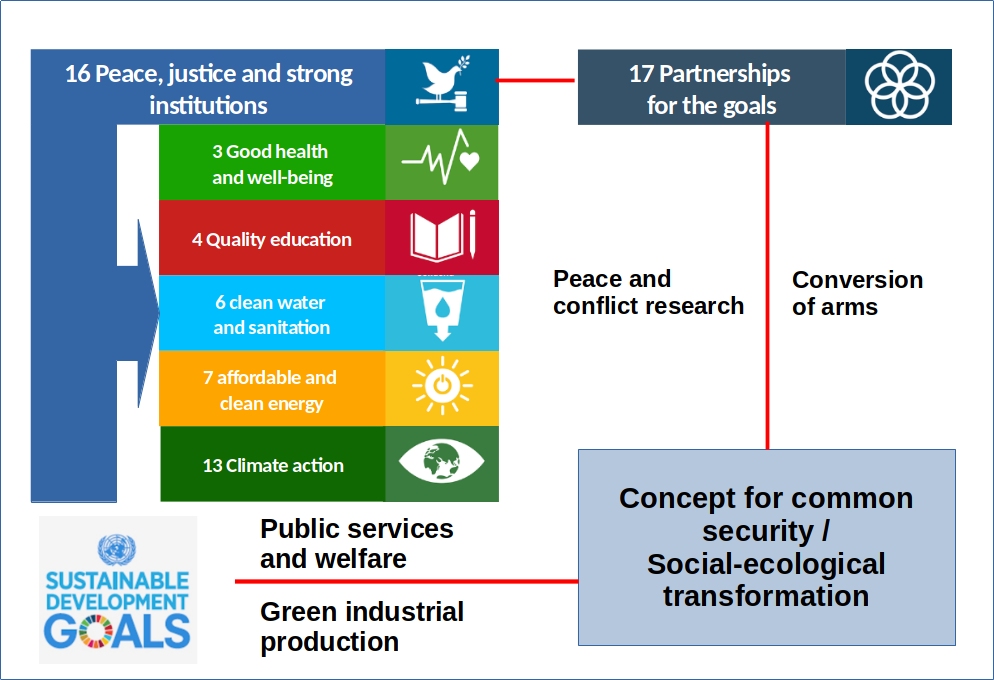
| Fig. 7-5: Political goals based on existing concepts In order to achieve the linked goals, cooperation between environmental and social associations is also necessary, as was developed, for example, before the 2021 Bundestag elections between BUND and the paritätische Gesamtverband under the keyword Agenda for the Future.-In the light of the current energy crisis and the resulting social protests, the linking of fundamental domestic and foreign policy demands must be put back on the agenda. |
The foreign policy-oriented concept for common security must be linked domestically with the concept of a socio-ecological transformation, which is also being discussed between environmental associations and the trade unions. For a fundamental reorientation of industrial policy, cooperation should be sought with national campaigns in other countries, which have also networked globally under „Global Climate Jobs“ with the slogan „One Million [new] Climate Jobs“.9https://www.globalclimatejobs.org/ Military disarmament is also a necessary step towards safeguarding public services, which is becoming increasingly urgent with growing challenges to resilience to the environmental and health effects of climate change. It would free up resources for climate change, avoid international conflicts and help end the shifting of financial burdens to future generations.
References
Common Security 2022 | International Peace Bureau
https://www.ipb.org/activities/common-security-report-2022/